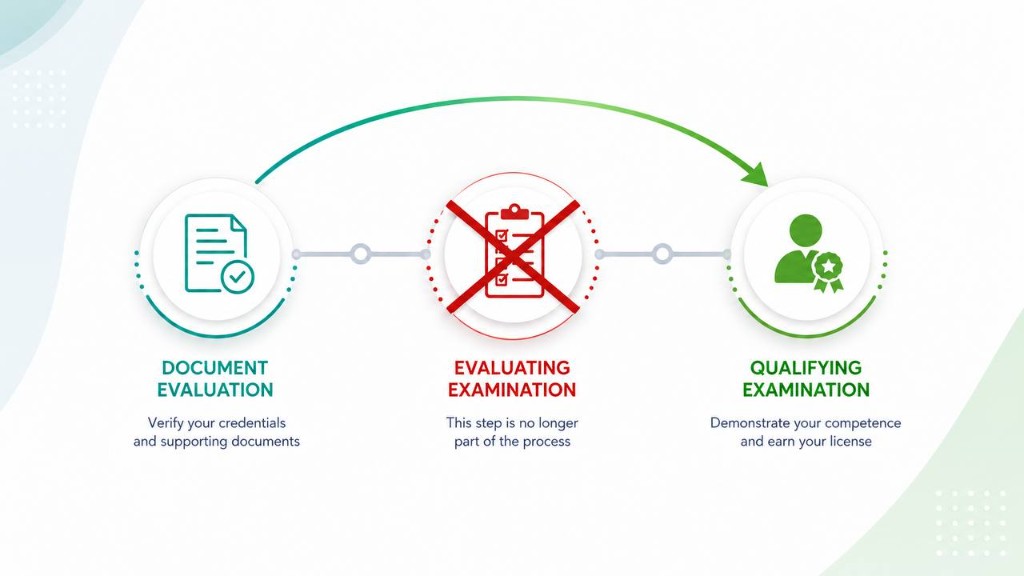
If you're an internationally trained pharmacist working toward Canadian licensure, PEBC just made one of the biggest changes to the certification pathway in years. Starting January 2027, the Pharmacist Evaluating Examination (EE) will no longer be a required step for International Pharmacy Graduates (IPGs). You'll be able to move from Document Evaluation straight into the Pharmacist Qualifying Examination.
For a pathway that has felt long and expensive for a long time, this is genuinely good news. But the details matter, and a few of them change how you should plan your next few months.
Why this matters
The EE was originally built as a screening step, a way to confirm that an internationally trained pharmacist had the basic science foundation before moving into the more Canadian-practice-focused Qualifying Examination. In practice, it added months, sometimes years, to a pathway that Canadian and US graduates never had to walk. It also meant studying a large volume of basic sciences content that, once you reached the MCQ and OSCE, only partially overlapped with what those exams actually test.
Removing it as a requirement doesn't remove Document Evaluation, and it doesn't lower the bar at the Qualifying Examination stage. What it does is collapse one full exam cycle, with its own application window, fee, and result wait, out of the pathway for most candidates.
What's actually changing
Right now, IPGs sit the EE before they're eligible for the Qualifying Examination (Part I MCQ and Part II OSCE). Canadian and US graduates never had to.
Effective January 2027, that requirement is gone. IPGs with a valid Document Evaluation can apply directly for Part I (MCQ). October 2026 will be the last sitting of the EE that PEBC offers at all.
That's the headline. Here's the part that's easy to miss.
The catch: MCQ before OSCE, unless you passed EE
Under the new no-EE pathway, you still have to successfully complete Part I (MCQ) before you're eligible to apply for Part II (OSCE). You can't sit both in the same session.
Candidates who did pass the EE (at any point, including if they take the optional October 2026 sitting and pass it) keep a real advantage: they can apply for Part I and Part II in any order, including the same exam session. That's the one thing the EE still buys you, and it's worth knowing before you decide whether the October 2026 sitting is worth your time.
Under the new pathway: MCQ first, then OSCE-no same-session dual sitting. Pass the EE (including October 2026) and you keep full Part I / Part II scheduling flexibility.
Who this helps most
If you're new to PEBC and have only completed Document Evaluation, or if you didn't pass EE on a previous attempt, this is a real shortcut. You go straight to Part I (MCQ) as if you'd already passed EE, without spending months reviewing the basic sciences content the EE was built around.
If you exhausted all four EE attempts, the same applies to you. PEBC's FAQ is explicit that you're eligible to continue toward certification under the new pathway, no remediation required. Previously, candidates who ran out of EE attempts faced a genuinely difficult position. Under the new pathway, that history stops mattering the moment you have a valid Document Evaluation.
This also removes a financial and time cost that candidates have long flagged as one of the hardest parts of the IPG pathway. One fewer exam means one fewer application cycle, one fewer result wait, and one fewer fee, all of which add up when you're also trying to work, relocate, or support a family while you get licensed.
If you were mid-study for the EE
This is the harder truth in the announcement. If you've spent the last months building a foundation for the EE, that time isn't reclaimed, and the October 2026 sitting is now optional rather than mandatory. The upside is that EE and MCQ content overlap heavily. Pharmacology, pharmacotherapy, pathophysiology, and clinical reasoning carry weight in both exams, so the studying wasn't wasted, just redirected.
What does change is where your focus should sit from here. The current MCQ blueprint hasn't moved, and Clinical Care alone accounts for half the MCQ weighting, with Distribution and Communication making up most of the rest. If EE prep had you deep in basic sciences that don't map to MCQ competencies, that's the area to pull back from now. Case-based clinical reasoning and pharmacotherapy are where the exam actually lives.
If you already passed EE
Nothing changes for you. Your Document Evaluation stays valid for the rest of your pathway, and you keep the flexibility to sit Part I and Part II in either order, or together.
One more door this opens
If you're an IPG candidate who's been considering the pharmacy technician route instead, or as a backup, PEBC confirmed that a valid Pharmacist Document Evaluation now qualifies you to apply directly for the Pharmacy Technician Qualifying Examination too, without a separate technician course. That's a meaningful option if licensure timelines or job market conditions have you weighing both paths.
What to actually do next
- Check your Document Evaluation's status. It's valid for five years from approval, and it needs to be current when you apply for Part I (MCQ). If it will expire before the exam window you're targeting, you'll need Document Re-evaluation completed at least two business days before the application deadline, and that process takes longer than two business days to arrange, so start early.
- If you're enrolled in the October 2026 EE, decide with the MCQ-before-OSCE tradeoff in mind, not just "do I still need this." Passing it still buys you the flexibility to sit both parts of the Qualifying Examination in any order.
- If you're withdrawing from the October 2026 EE, note the refund window. Candidates who applied and paid on or after April 30, 2026 can withdraw for a full refund through August 24, 2026. After that date, standard withdrawal policy applies, and there's no refund for an exam already taken.
- If you were EE-focused, shift your review toward the clinical and pharmacotherapy content the MCQ blueprint weights most heavily.
- The four-attempt maximum for Part I and Part II hasn't changed, so treat your first MCQ attempt as seriously as you would have treated the EE.
- Watch for PEBC's new readiness tool. A short sample MCQ assessment tool was set to become available in mid-August 2026, with more resources planned for 2027, giving candidates a way to gauge where they stand before committing to an exam date.
This is a shorter pathway for a lot of candidates. It's not a free pass, and the fine print about exam sequencing is worth planning around before you decide how to spend the next few months.
References
- • PEBC. New Certification Pathway for IPGs.
Hassan Torkamandi, PharmD, RPh
CEO, Simulabs Technologies Inc.