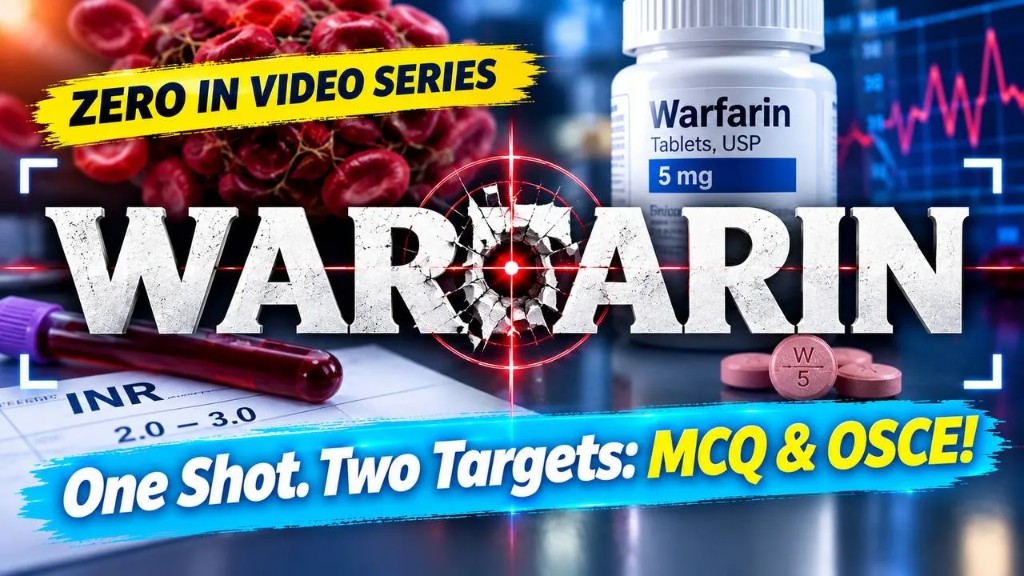
Why Warfarin Matters on Exam Day
Unlike many medications with predictable dosing, warfarin therapy is variable and decision-heavy. Exam questions often test whether you can recognize risk, interpret INR results, adjust therapy safely, and communicate a clear plan. The Zero IN series starts here because warfarin rewards precise clinical reasoning under pressure — exactly what MCQ and OSCE formats demand.
What This Review Covers
Use this video as a structured study pass before practice questions or mock stations:
- • Core indications and absolute/relative contraindications you need to recall quickly
- • Monitoring principles, including INR interpretation and high-INR management scenarios
- • Dosing strategy and factors that push INR up or down
- • High-yield drug and food interactions that change clinical decisions
- • When and how to consider switching between warfarin and DOACs
- • Quiz-style application so theory transfers to case-based exam items
How to Study This Topic for MCQ vs OSCE
For MCQs: Focus on pattern recognition — target INR ranges, interacting drugs, contraindications, and the safest next step when INR is elevated or therapy needs to change.
For OSCEs: Practice turning those facts into a consultation. Confirm indication and bleeding risk, explain monitoring, counsel on interactions and adherence, and outline a clear follow-up plan when INR or therapy changes.
Shared skill: Both formats reward candidates who can prioritize patient safety — recognizing when to hold, adjust, reverse, refer, or transition therapy rather than memorizing isolated numbers.
High-Yield Clinical Checkpoints
As you watch, pause and test yourself on these decision points:
- Indication fit — Is anticoagulation still appropriate for this patient?
- Contraindication screen — Any major bleeding risk, adherence barriers, or absolute stops?
- INR interpretation — Is the value therapeutic, subtherapeutic, or dangerously high?
- Adjustment plan — Hold, reduce, increase, reverse, or escalate care?
- Switching logic — When is a DOAC transition appropriate, and what sequencing matters?
- Communication — Can you explain the plan clearly to a patient, nurse, or examiner?
Common Exam Pitfalls
Candidates often lose marks by:
- • Memorizing INR targets without linking them to the clinical indication
- • Missing major interacting medications or lifestyle factors that shift INR
- • Treating every elevated INR the same, without stratifying bleeding risk
- • Recommending a DOAC switch without checking indication, renal function, or transition timing
- • Knowing the pharmacology but failing to state a clear next clinical action
Key Takeaway
Warfarin exam success comes from decision-making, not rote recall. If you can identify risks, interpret INR in context, adjust therapy safely, and explain transitions to or from DOACs, you are prepared for both multiple-choice questions and anticoagulation OSCE scenarios.
Watch the Zero IN breakdown below, then apply the same checkpoints to practice cases.
Watch the Video Tutorial
Watch on YouTube: Pharmacy Exam Prep: Warfarin for MCQ and OSCE Exams | Zero IN Series � Simulabs AI on YouTube
Disclaimer
This content is not intended as a practice reference or clinical treatment resource. It is designed solely to enhance pharmacists' knowledge and skills for the purpose of preparing for pharmacy examinations. This video is not a substitute for current clinical guidelines and should not be used as a reference for patient care or clinical practice.
Please note that some of the information presented may differ slightly from guidelines in different countries or from routine clinical treatment practices. Always refer to the applicable, up-to-date clinical guidelines and local protocols when making clinical decisions.
Hassan Torkamandi, PharmD, RPh
CEO, Simulabs Technologies Inc.
Ready to Apply This in Practice Stations?
Reinforce anticoagulation decision-making with interactive OSCE practice and detailed performance feedback.
Start Your Practice